
Let’s stop pretending the AI conversation in advertising is still about tools.
That part is over.
The market has already been flooded with image models, video generators, avatar platforms, editing tools and workflow hacks. Everyone can make more. Everyone can move faster. Everyone can point to some kind of AI-enabled capability. The novelty has worn off.
What matters now is something else entirely: how the work is orchestrated.
Because the next competitive edge in advertising will not come from having access to more AI tools. It will come from building a smarter creative system around them. That is the real shift now underway: AI moving from a set of isolated capabilities to something embedded deeper in the workflow and operating model of modern marketing teams.
Access is no longer the advantage
We have reached the point where access to AI is accessible, cheap, easy and increasingly standard.
That changes the game. Once everyone can generate an image, cut a video, write a script or spin up ten variants of a concept, output itself stops being the advantage. The differentiator moves elsewhere: into judgement, taste, structure, governance and the ability to turn creative possibility into commercial effectiveness.
That is why the more useful question is no longer, “What tool are you using?” but, “What kind of creative machine are you building?”
More content is not the same as better advertising. One of the most dangerous misconceptions in the current AI rush is the belief that speed automatically creates value.
It doesn’t.
More assets do not necessarily mean better advertising. More versions do not necessarily mean better performance. More automation does not automatically produce stronger ideas, sharper storytelling or more meaningful brand distinctiveness.
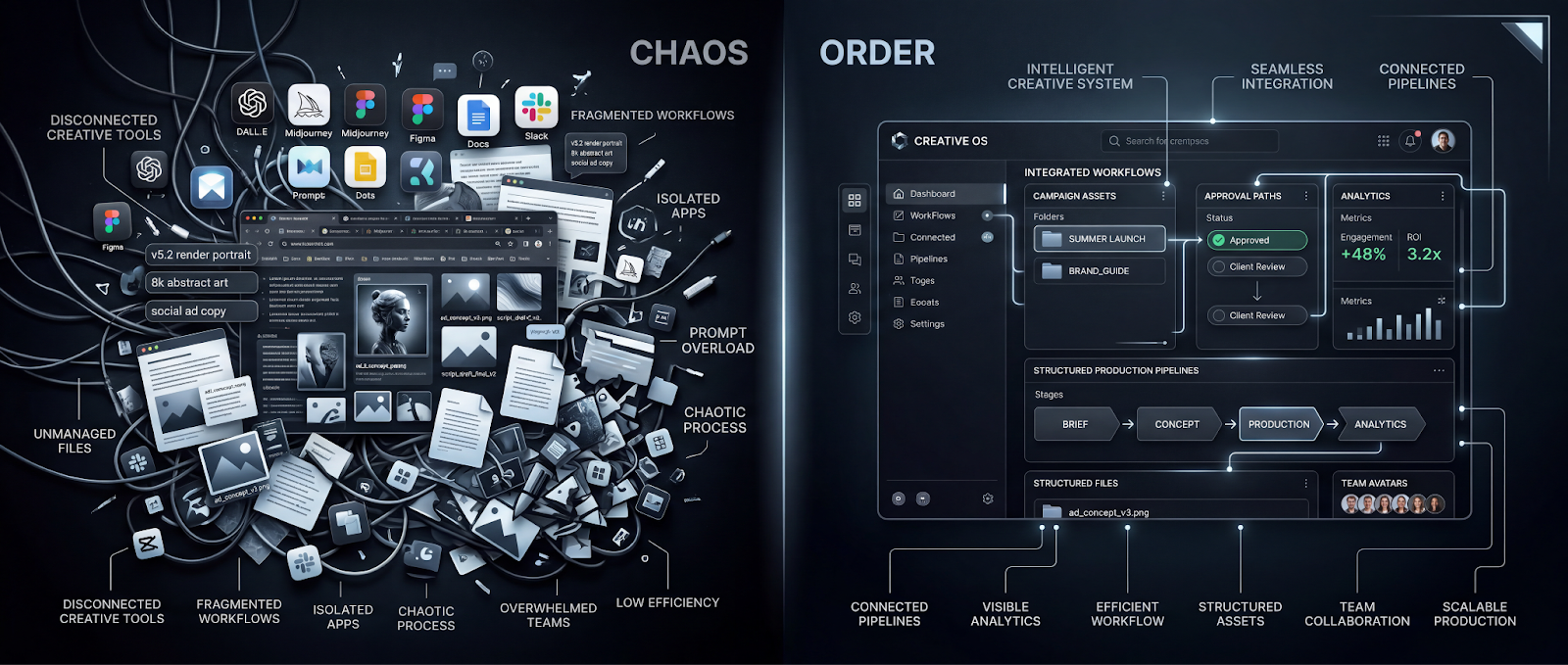
In fact, many teams are discovering the opposite. They’ve added more AI tools into the mix, but what they’ve really created is a bigger coordination problem: more fragmented workflows, more manual handoffs, more version management, more disconnected insights and more content that looks polished but says very little.
That is the core limitation of most point solutions: they optimise steps, not systems.
The market is moving from production capability to creative infrastructure
What the industry is finally starting to understand is that the future isn’t about stacking point solutions together and hoping the whole becomes smarter.
It is about infrastructure.
The centre of gravity is shifting from isolated production tasks to end-to-end systems that connect creation, iteration, learning and performance. That is where things get interesting.
Once you stop thinking about AI as a tool and start thinking about it as infrastructure, the conversation changes completely. You stop asking how to make content faster and start asking how to design a workflow that is smarter from end to end. You stop thinking in terms of one-off outputs and start thinking in terms of creative operating systems.
The next shift is agentic workflows
This is the piece most people still aren’t talking about clearly enough.
The next real shift is not simply better generation. It is agentic orchestration.
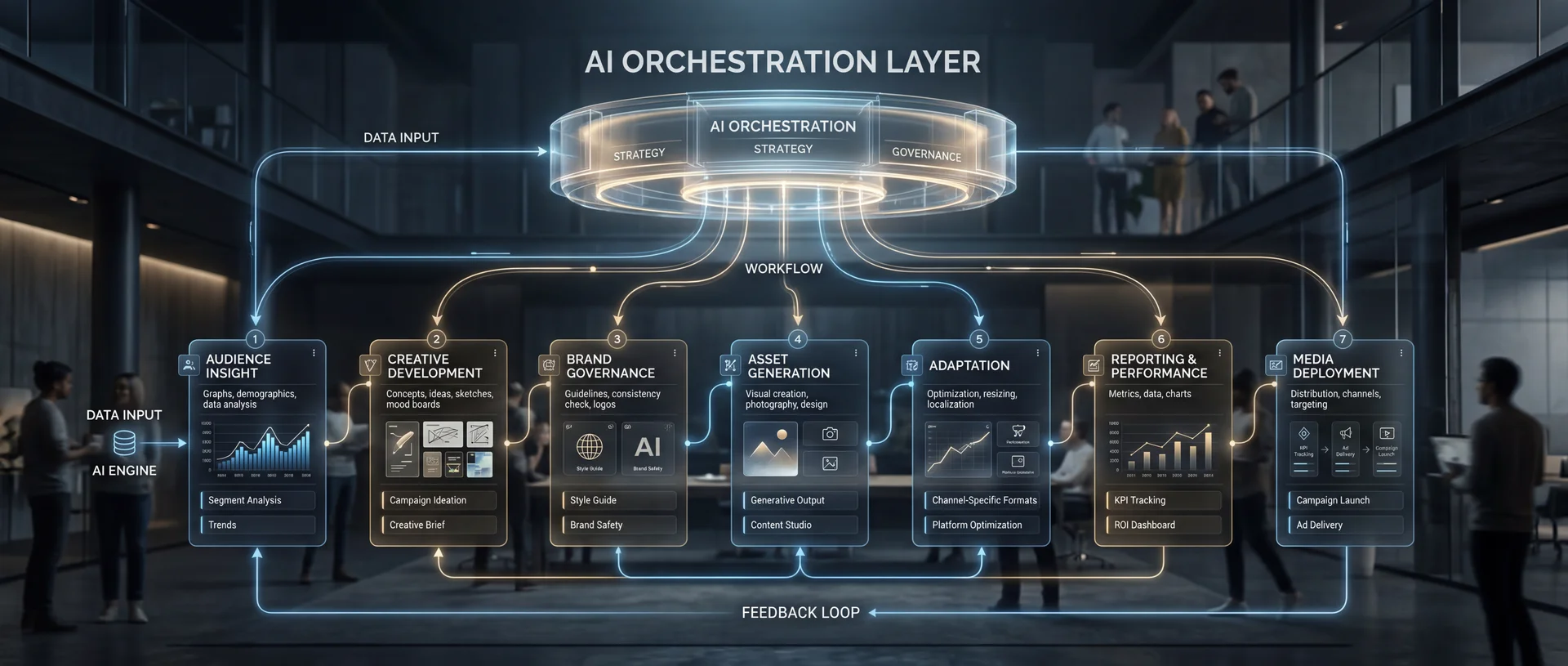
In practical terms, that means AI models will increasingly sit above the workflow as an orchestration layer, coordinating specialist agents across the creative process. One agent might pull together market and audience research. Another could analyse past campaign performance. Another could generate strategic territories. Another could build first-draft scripts or storyboards. Others could handle adaptation, QA, versioning, brand checks, channel formatting, metadata, approvals and reporting.
That is where the conversation starts to move beyond “AI making stuff” and into “AI managing complexity”.
And that is a far bigger opportunity.
Because the real problem in modern marketing is not a lack of tools. It is the operational drag that sits between insight and execution. Agentic workflows offer a path to reduce that drag by linking people, systems, data and creative outputs in a far more coordinated way.
The brands that win will build custom creative systems, not generic AI stacks
This is where the market will start to split quite sharply.
On one side, you’ll have businesses relying on generic tools, public models and disconnected SaaS subscriptions. They will be able to make more things more quickly, but they will still struggle with consistency, control and meaningful learning loops.
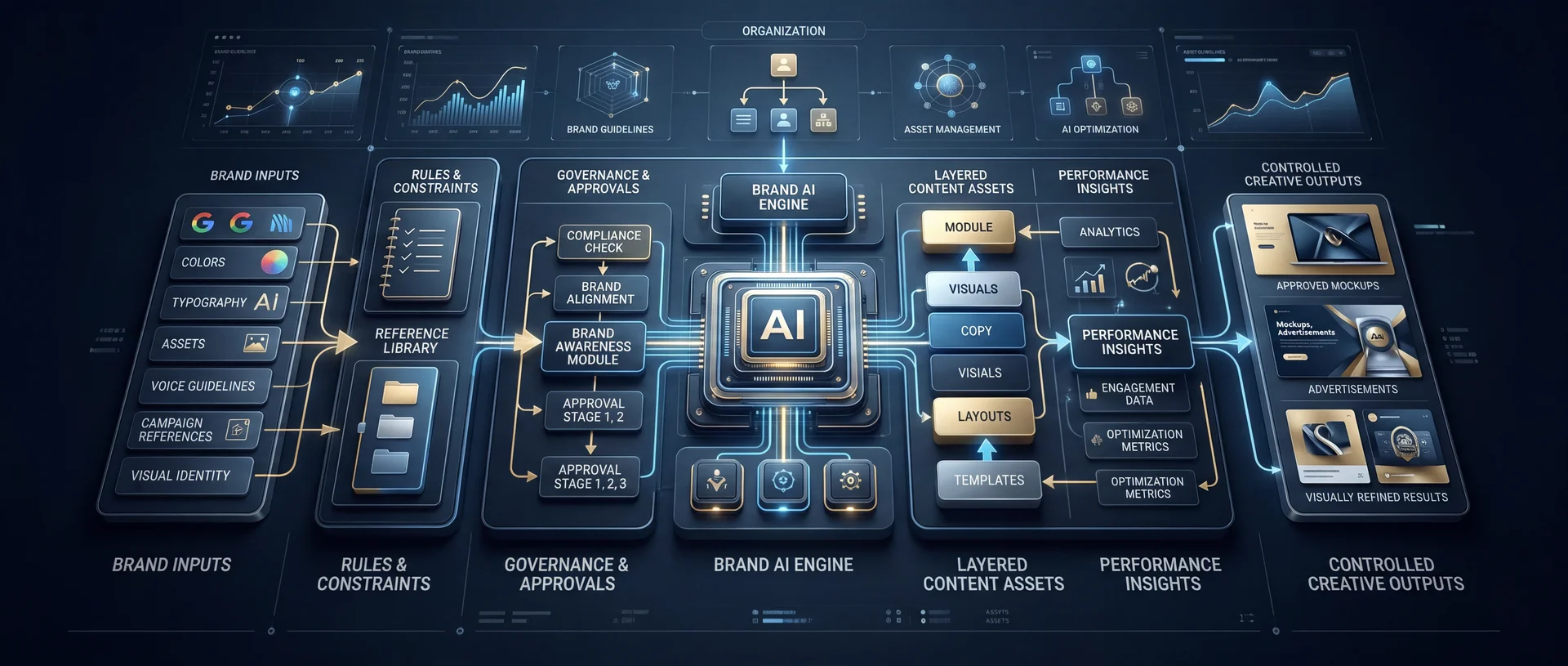
On the other side, you’ll have businesses building custom systems around their own brand data, visual references, rules, workflows and commercial priorities. These systems will be more secure, more adaptable and far more useful because they are not just generating outputs. They are operating within a defined creative and strategic environment.
That distinction matters enormously.
At Now We Collide, that is how we think about COLLIDE-AI. It sits inside a broader integrated model spanning strategy, creative, production, digital and media - designed as a AI creation platform working with custom agents, uploaded brand data and controlled output parameters across text, image and video.
That is not just about using AI. It is about building a system that is actually useful to the brand.
Taste becomes even more important in an AI-heavy market
There’s a lazy narrative floating around that AI will flatten the role of creative leadership.
I think the opposite is true.
The easier it becomes to make things, the more obvious it becomes who has genuine taste and who doesn’t. When the machine can produce endless polished outputs, the real value lies in knowing what should exist in the first place, what deserves to be pushed further, what should be killed immediately, what feels native to platform, what feels premium, what feels strategically sharp and what is just more generic sludge dressed up as innovation.
That’s the real moat.
Not the prompt.
Not the tool.
Not the speed.
The judgement behind the system.
And no model, no matter how strong, removes the need for that. If anything, it makes it more visible.
The opportunity is bigger than automation
Too many businesses are still framing AI as a cost conversation.
How do we do the same thing faster?
How do we reduce production overhead?
How do we get more assets for less?
Those are fair questions. They’re just not the most exciting ones.
The more powerful question is: what does this now make possible that wasn’t previously practical?
That is where AI gets genuinely valuable.
It opens up new ways to prototype ideas earlier. New ways to build visual worlds when traditional production would be too slow or too expensive. New ways to create modular content systems that can stretch across platforms. New ways to personalise, adapt and iterate without starting from scratch every time. And, increasingly, new ways to connect intelligence to execution through orchestration rather than brute-force labour.
COLLIDE-AI has already been built in that spirit: not simply as a shortcut, but as a way to create rights-owned synthetic photography and video, accelerate concept development and open up new creative and production possibilities across brand and campaign work.
Agencies need to decide what business they are actually in
This is where AI becomes uncomfortable for a lot of agencies.
If your commercial model depends on friction, manual production, endless versioning and slow-turnaround execution, then yes, AI is a threat. It exposes how much of the value chain was built around labour inefficiency.
But if your value lies in strategy, ideas, systems thinking, platform understanding, brand stewardship, production intelligence and the ability to integrate all of that into work that actually performs, then AI is not the threat. It is the leverage.
That is the dividing line.
The agencies that win from here won’t be the ones casually bolting AI onto yesterday’s operating model. They’ll be the ones redesigning the model itself: combining human judgement with orchestration layers, specialist agents, secure data environments and production systems that are built to learn over time.
The future belongs to orchestrated creative systems
The industry spent the last few years obsessing over what AI can generate.
The next few years will be defined by how well organisations can orchestrate it.
That means connected systems, not disconnected apps. Custom agent frameworks, not one-size-fits-all automation. Brand-aware workflows, not generic output engines. Human creative leadership sitting above intelligent systems, not being replaced by them.
That is where the real opportunity sits.
At Now We Collide, that is the lens we are focused on: the intersection of strategy, creativity, production, media and AI working as one intelligent operating system, not as separate departments awkwardly stitched together after the fact. COLLIDE-AI sits alongside strategy, creative, production and media as part of that broader integrated model.
That is the shift.
AI won’t magically solve advertising.
But it will radically reshape how advertising gets built.
And in doing so, it will expose which teams were selling process, and which ones were actually building capability.
The winners won’t be the ones with the most tools.
They’ll be the ones with the best creative system.
If you are interested in hearing more about how AI can impact your organisation's marketing and communications, drop us a line below!